Science
Everything in the Science section is sourced. These are not the same as the Opinions section and I will not pretend they are. Every ingredient in Perimeter has a corresponding article here — so you can read the same primary research I read and verify the reasoning yourself.
The Science · The Library · By Sara Kirkwood, Founder of Improve Equine · September 2026 If you’re going to give your horse Gatorade, at least let’s update the information you have about it — and make sure you know there are better alternatives. So, there’s a very popular video going around right now of […]
Read More →The Science · The Library · By Sara Kirkwood, Founder of Improve Equine · June 2026 “Natural” and “proven” are not the same word, and neither are “a plant” and “a drug.” Before we ever get to which herbs do what in a horse, it’s worth slowing down on what these words actually mean — […]
Read More →The supplement aisle is one of the least regulated places a horse owner spends money. Here are the seven questions I run before I trust a product — study, dose, form, survival, ceiling, mechanism, and population.
Read More →The Science · The Library · By Sara Kirkwood, Founder of Improve Equine · June 2026 A horse loses minerals in a very specific pattern when it sweats and most of what we reach for to replace them may be solving a problem the horse didn’t have — or worse, creating one. So let’s start […]
Read More →Follow the Money: What the Horse World Pays to Learn The Science · The Library · By Sara Kirkwood, Founder of Improve Equine · June 2026 I went looking for proof that a more varied diet builds a more resilient horse. What I found instead was a map of who pays for equine science — […]
Read More →By Sara Kirkwood, Founder of Improve Equine · June 2026 — Choke gets treated as a feeding-management problem. But it's really a saliva problem — and the things that prevent it are dentition, feed that makes a horse chew instead of bolt, and hydration.
Read More →Written by Sara Kirkwood in The Science The maintenance baseline and the three things that cover it before you consider additional supplementation. Most horse owners walk out of a feed store feeling like they’re underdoing it. The aisles are long, the marketing is confident, the labels are dense, and the implicit message is that figuring […]
Read More →Refusing food because it smells wrong is not stubbornness. It is an evolutionary safety latch — and the fix is almost never a new supplement.
Read More →Docosahexaenoic acid (DHA) is a long-chain omega-3 polyunsaturated fatty acid found in highest concentrations in marine algae — the original biosynthetic source from which all dietary DHA ultimately derives. DHA and its downstream metabolites play a central role in resolving inflammation, modulating mast cell activity, and supporting immune regulation in both horses and other mammals. […]
Read More →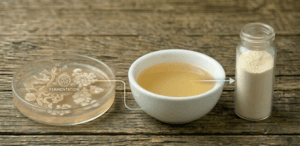
Ascorbyl palmitate is the fat-soluble (lipophilic) ester form of Vitamin C. Unlike standard ascorbic acid — which is water-soluble and clears from the body relatively quickly — ascorbyl palmitate integrates into lipid membranes and fatty tissues, providing extended antioxidant protection at the cellular level. This distinction matters for immune function, tissue defense, and the specific […]
Read More →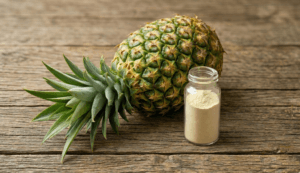
Bromelain is a proteolytic enzyme complex extracted from pineapple (Ananas comosus) stem. Beyond its own significant anti-inflammatory properties, bromelain plays a critical synergistic role with quercetin — enhancing its bioavailability and potentiating its effects at the site of action. This combination has been validated in peer-reviewed research on the mechanisms of flavonoid absorption and immune […]
Read More →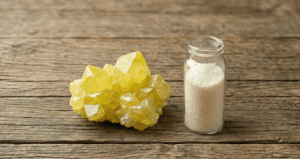
Not all MSM is the same. The method by which methylsulfonylmethane is produced has a profound impact on its purity, contaminant profile, bioavailability, and stability. OptiMSM® (manufactured by Bergstrom Nutrition) is the only MSM produced in the United States using a multi-stage distillation process — a fundamentally different and superior manufacturing approach compared to the […]
Read More →Methylsulfonylmethane (MSM) is an organosulfur compound that serves as a bioavailable source of dietary sulfur — an essential element in collagen synthesis, glutathione production, and inflammatory pathway regulation. MSM has been extensively studied for its anti-inflammatory, antioxidant, and immunomodulatory properties, with applications particularly relevant to equine joint health, respiratory inflammation (heaves/equine asthma), and hypersensitivity skin […]
Read More →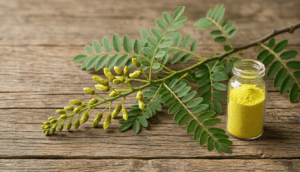
Quercetin is a powerful anti-allergic and anti-inflammatory flavonoid, but it faces a significant limitation: poor oral bioavailability. In its aglycone (free) form, quercetin is only approximately 4% bioavailable after oral administration. Isoquercetin (quercetin-3-O-glucoside, also called isoquercitrin) is a naturally occurring glycoside form of quercetin that is absorbed more rapidly and at significantly higher levels — […]
Read More →Quercetin is a naturally occurring flavonoid found in many plants. It is one of the most extensively studied natural compounds for its ability to inhibit mast cell degranulation — the process that releases histamine and other pro-inflammatory cytokines responsible for allergic symptoms. Research consistently shows quercetin outperforms pharmaceutical mast cell stabilizers in human cell studies. […]
Read More →Spirulina (Arthrospira platensis) is a blue-green microalgae with well-documented anti-inflammatory properties. Research demonstrates that spirulina directly inhibits mast cell degranulation — the process by which mast cells release histamine and other inflammatory mediators that drive allergic reactions. Key Research Inhibitory Effect on Mast Cell-Mediated Immediate-Type Allergic Reactions Kim HM, Lee EH, Cho HH, Moon YH. […]
Read More →Opinions
These are opinions. They are clearly labeled as such. I think the difference between opinion and sourced science matters — and I will never blur that line. The five most recent opinion pieces and guest voices are below. Read all opinions in the archive →
Opinion · The Library · By Sara Kirkwood, Founder of Improve Equine · July 2026 Last week I asked what’s stopping you. A reader pushed back with a true and honest take on consequences that was worth it’s own thoughtful response. A response that made me think Last Friday I asked what’s stopping you from […]
By Sara Kirkwood, Founder of Improve Equine · July 2026 There’s the moment you decide to do something better — and then there’s actually doing it, again and again, until it’s just how you do things. These are the areas of friction that prevent me from taking the actions. The seed For me, a change […]
Opinion · The Library · By Sara Kirkwood, Founder of Improve Equine · July 2026 Horses have long been viewed as livestock. So everything we invest in them tends to arrive with a question attached: yeah, but what does it do? The question we attach to horses When people find out I have horses they […]
I yell in the barn sometimes, and I carry a lot of shame about it. But my horses don't perceive it the way I do — and the real work isn't to never have a human moment. It's the untangling: keeping what's good, looking honestly at what isn't, and stopping the habit of treating my own humanness as the thing that has to be trained out of me.
Opinion · The Library · By Sara Kirkwood, Founder of Improve Equine · June 2026 We all agree our horses need a hydration strategy. The question is what you can do with what you have, in the time you’ve got — and why doing some of it always beats waiting until you can do all […]
Things you can actually use today.
Hydration protocols, palatability, metabolic safety, travel and show prep, medication compliance. The practical application of everything else in The Library. The three most recent are below. See all practical guides →
Practical
Masking Medication: How to Get a Horse to Take What They Need
Getting a horse to take unpalatable medication is one of the most frustrating daily battles in horse ownership. Here's why most masking strategies fail — and what actually works long-term.
Read the Guide →Practical
Keeping Horses Hydrated in Florida: Heat, Water Quality, and What to Do About It
Florida horses need significantly more water than horses in temperate climates — and Florida well water creates its own set of challenges. Here's what I learned after moving my herd to Land O' Lakes.
Read the Guide →Practical
The Water Buffet Method: How to Find Your Horse’s Favorite Flavor
The Water Buffet method isn't a product — it's an approach. Give your horse options, watch what they choose, and let their body tell you what it needs. Here's how to run one.
Read the Guide →The Library is a living document.
New research breakdowns, ingredient deep-dives, and the occasional hot take get added regularly. Every article is sourced, labeled, and written by someone who actually read the studies — not a content team. The full archive lives at /blog/.