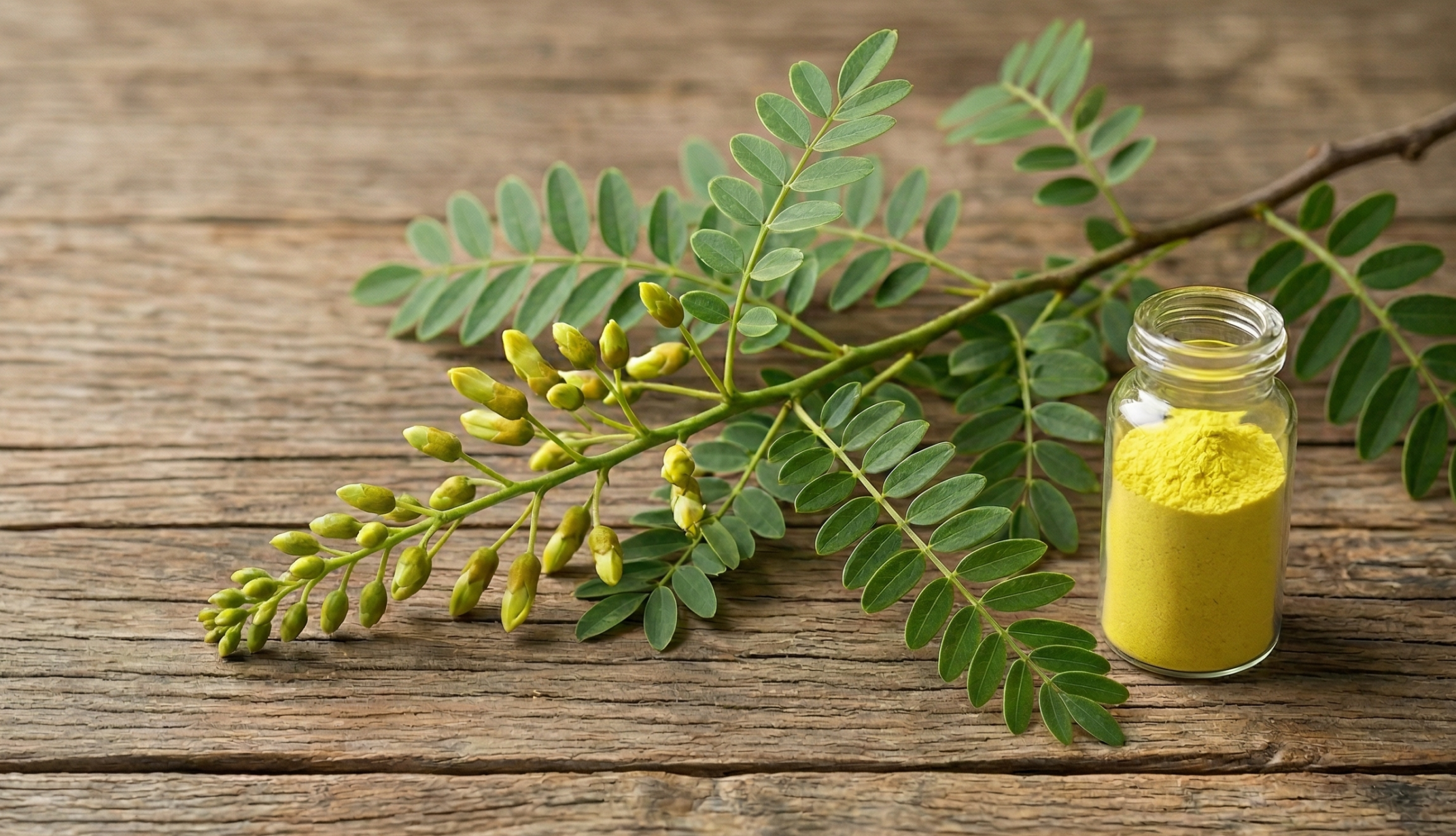
Quercetin is a powerful anti-allergic and anti-inflammatory flavonoid, but it faces a significant limitation: poor oral bioavailability. In its aglycone (free) form, quercetin is only approximately 4% bioavailable after oral administration. Isoquercetin (quercetin-3-O-glucoside, also called isoquercitrin) is a naturally occurring glycoside form of quercetin that is absorbed more rapidly and at significantly higher levels — making it the preferred form for systemic anti-inflammatory and anti-allergic applications.
Key Research
Oral Bioavailability of Quercetin from Different Quercetin Glycosides in Dogs
Reinboth M, Wolffram S, Abraham G, Ungemach FR, Cermak R. British Journal of Nutrition. 2010 Jul;104(2):198–203.
DOI: 10.1017/S000711451000053X | PMID: 20230651
This University of Leipzig study conducted in dogs — a relevant mammalian model — directly compared the bioavailability of quercetin aglycone versus isoquercetin (isoquercitrin) and rutin at equivalent molar doses. Key findings:
- The absolute bioavailability of quercetin aglycone was only ~4% — the vast majority is not absorbed systemically
- Isoquercetin (isoquercitrin) was 1.5× more bioavailable than quercetin aglycone, with faster absorption peaking earlier
- Both quercetin and isoquercetin were primarily absorbed in the small intestine, with peak plasma concentrations of 0.89 µmol/L achieved with isoquercetin
- The superior bioavailability of isoquercetin relates to its glucoside form: the glucose moiety allows recognition by sodium-dependent glucose transporters (SGLT1) in the small intestine wall, enabling direct uptake rather than requiring colonic microbial hydrolysis
Enzymatically Modified Isoquercitrin Is Absorbed More Easily Than Other Quercetin Glycosides
Makino T, Shimizu R, Kanemaru M, et al. Biological and Pharmaceutical Bulletin. 2009 Dec;32(12):2034–40.
DOI: 10.1248/bpb.32.2034 | PMID: 19952424
This study demonstrated that glucoside-conjugated forms of quercetin (including isoquercetin) are absorbed significantly more efficiently in the small intestine compared to the aglycone or rutin forms, with higher peak plasma concentrations and faster time to maximum concentration (Tmax). The study attributed this to direct transporter-mediated uptake rather than passive diffusion.
Why Bioavailability Matters
The biological activity of quercetin depends entirely on reaching systemic circulation. A compound that remains largely in the gut cannot stabilize mast cells in the airways, skin, or joints. Isoquercetin’s superior absorption means a given dose delivers meaningfully more active compound to target tissues — including the respiratory mucosa, dermal mast cells, and synovial tissues relevant to equine inflammatory conditions.
Relevance to Equine Supplementation
For horses supplemented to support histamine response, airway health, or skin conditions, the form of quercetin used in a supplement has a direct impact on efficacy. Isoquercetin’s 1.5× greater bioavailability compared to quercetin aglycone means more active compound reaches the tissues where mast cell stabilization is needed most.
Note: These studies provide mechanistic and comparative evidence for isoquercetin’s superior absorption. Always consult a veterinarian regarding your horse’s specific health needs.
Frequently Asked Questions: Isoquercetin for Horses
What is isoquercetin and why is it better than regular quercetin for horses?
Short answer: Isoquercetin is the glycoside form of quercetin — it is absorbed 1.5× more efficiently because the attached glucose molecule allows it to use intestinal glucose transporters rather than relying on slower passive diffusion. Standard quercetin aglycone has only about 4% oral bioavailability, meaning 96% of what you give your horse passes through without entering circulation. Isoquercetin peaks faster and reaches higher plasma concentrations, which matters when the therapeutic goal is reaching mast cells in the skin, airways, and joints. For horses with allergic conditions where quercetin’s anti-inflammatory benefits are needed systemically, the form you supplement with has a direct impact on whether it works.
Is isoquercetin safe for horses with sweet itch or insect bite hypersensitivity?
Short answer: Yes — isoquercetin’s superior bioavailability makes it more effective than standard quercetin for horses with insect bite hypersensitivity, sweet itch, and other IgE-mediated allergic skin conditions. The mast cells in equine skin that drive insect bite hypersensitivity responses are exactly the target of quercetin-family compounds. Because isoquercetin reaches systemic circulation at higher concentrations than standard quercetin, it delivers more of the active mast cell-stabilizing compound to dermal tissue. Combined with spirulina and bromelain, it forms the core of a science-based equine allergy support protocol.
How does bromelain interact with isoquercetin in horses?
Short answer: Bromelain further enhances quercetin and isoquercetin absorption by breaking down the protein matrix in the gut that can interfere with flavonoid uptake, producing synergistic bioavailability effects beyond what either compound achieves alone. Bromelain is a proteolytic enzyme that has been specifically studied for its ability to enhance quercetin bioavailability. The combination of isoquercetin (already high-bioavailability quercetin) plus bromelain represents a compounding absorption advantage. See the bromelain absorption research article for the mechanism details.
Can isoquercetin help horses with heaves or equine asthma?
Short answer: Yes — isoquercetin’s superior systemic bioavailability means more quercetin reaches the respiratory mucosa where mast cell stabilization is needed for horses with heaves, RAO, and inflammatory airway disease. Equine asthma and heaves involve chronic mast cell-driven inflammation in the airways. The quercetin delivered via isoquercetin suppresses IgE receptor signaling and NF-κB activation — both key drivers of airway inflammatory responses. Because respiratory tissue is a systemic target (not a gut target), the higher plasma concentrations achieved with isoquercetin are particularly meaningful for horses with airway conditions.
What is the full quercetin-family stack for equine allergy support?
Short answer: The most research-supported quercetin-family approach for horses combines quercetin + isoquercetin + bromelain — each addressing a different aspect of absorption and inflammatory pathway suppression for comprehensive mast cell support. Quercetin provides broad-spectrum mast cell stabilization. Isoquercetin provides higher systemic bioavailability of quercetin. Bromelain enhances absorption of both and adds its own anti-inflammatory effects. Together with spirulina (which works via a separate cAMP-dependent mechanism), this stack covers the allergic cascade from multiple directions. Read the full research in the quercetin article, spirulina article, and bromelain article. For overall context on equine health and hydration, see the Complete Guide to Horse Hydration.
Leave a Reply