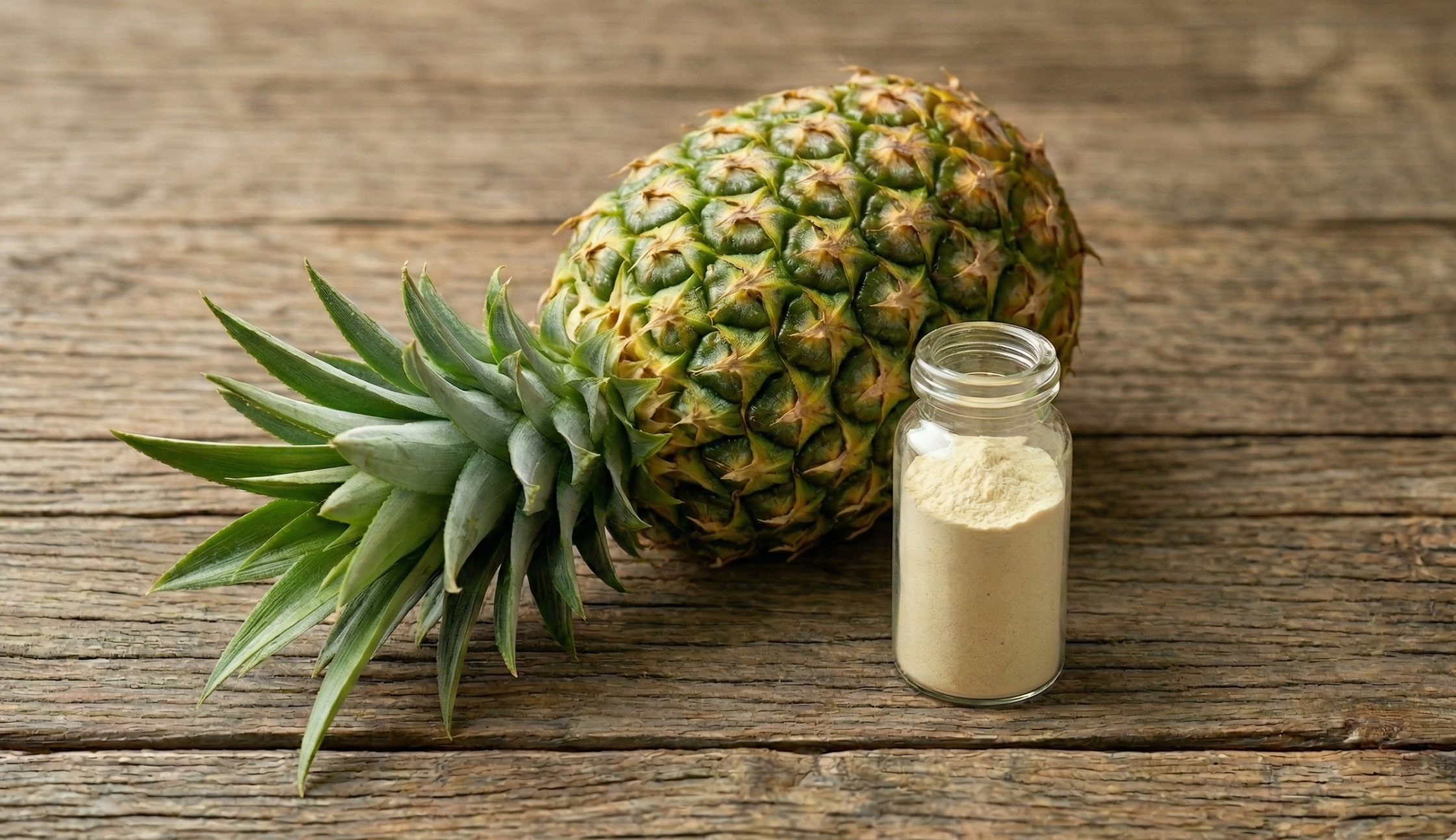
Bromelain is a proteolytic enzyme complex extracted from pineapple (Ananas comosus) stem. Beyond its own significant anti-inflammatory properties, bromelain plays a critical synergistic role with quercetin — enhancing its bioavailability and potentiating its effects at the site of action. This combination has been validated in peer-reviewed research on the mechanisms of flavonoid absorption and immune modulation.
Key Research
Bromelain as a Natural Anti-Inflammatory Drug: A Systematic Review
Nobre TA, de Sousa AA, Pereira IC, et al. Nat Prod Res. 2025 Mar;39(5):1258–1271.
DOI: 10.1080/14786419.2024.2342553 | PMID: 38676413
This systematic review evaluated bromelain’s anti-inflammatory activity across in vitro studies on multiple cell lines. Key findings relevant to allergy and inflammation:
- Bromelain reduced IL-1β, IL-6, and TNF-α secretion in immune cells stimulated by pro-inflammatory cytokines — modulating the inflammatory cascade rather than suppressing it indiscriminately
- The mechanisms include reduction in prostaglandin synthesis and activation of neutrophil-regulating pathways that parallel the mechanisms of quercetin’s mast cell stabilization
- Bromelain’s effects were consistent across multiple immune cell types, supporting its role as a broadly acting natural anti-inflammatory agent
The Mechanism: How Bromelain Enhances Flavonoid Absorption
Bromelain enhances quercetin absorption through several complementary mechanisms:
- Gut permeability modulation: Bromelain selectively modifies tight junctions in intestinal epithelium, facilitating paracellular and transcellular absorption of large molecules including flavonoids
- Mucolytic action: By breaking down mucus in the GI tract, bromelain reduces the diffusion barrier between the gut lumen and absorptive epithelial cells
- Reduced first-pass metabolism: Bromelain’s anti-protease activity may protect quercetin from premature enzymatic degradation before absorption
- Synergistic anti-inflammatory effects: Bromelain itself inhibits prostaglandin synthesis, bradykinin, and NF-κB activation — complementing quercetin’s mast cell-stabilizing mechanisms
Bromelain’s Independent Anti-Inflammatory Properties
Rathnavelu V, Alitheen NB, Sohila S, Kanagesan S, Ramesh R. Biomedical Reports. 2016 Sep;5(3):283–288.
DOI: 10.3892/br.2016.720 | PMID: 27602208 | Free PMC Article
Beyond its role as an absorption enhancer, bromelain has been shown to independently reduce inflammatory cytokines, inhibit platelet aggregation, and modulate immune cell activity. This study covers bromelain’s potential clinical and therapeutic applications in inflammatory conditions, including its inhibition of NF-κB signaling, COX-2 expression, and pro-inflammatory eicosanoid pathways. This means the bromelain in Benchmark contributes directly to the formula’s anti-inflammatory activity in addition to improving the delivery of other ingredients.
The Benchmark Formulation Rationale
Benchmark includes bromelain specifically because quercetin’s effectiveness is limited by its absorption. By pairing isoquercetin (the most bioavailable quercetin form) with bromelain (an absorption enhancer with its own anti-inflammatory properties), Benchmark is designed to maximize the amount of active quercetin that reaches systemic tissues — including airway mucosa, skin, and joints — where mast cell stabilization matters most for your horse.
Note: These studies provide evidence for bromelain’s anti-inflammatory mechanisms and its role in enhancing quercetin bioavailability. Always consult a veterinarian regarding your horse’s specific health needs.
Frequently Asked Questions: Bromelain for Horses
What does bromelain do for horses?
Short answer: Bromelain serves two roles in equine supplementation — it is an independent anti-inflammatory agent that reduces IL-1β, IL-6, TNF-α, NF-κB, and COX-2 activity, and it simultaneously enhances the absorption of quercetin and other flavonoids by improving gut permeability and reducing the diffusion barrier in the GI tract. For horses on a quercetin-based allergy or inflammation support protocol, bromelain is not just an addition — it is a multiplier. By improving quercetin bioavailability while contributing its own anti-inflammatory activity, bromelain allows the full quercetin-family stack to perform significantly better than any single ingredient could achieve alone.
Why is bromelain paired with quercetin in horse supplements?
Short answer: Quercetin’s major limitation is poor oral bioavailability — bromelain addresses this directly by modifying intestinal tight junctions to improve absorption, breaking down mucus diffusion barriers, and protecting quercetin from premature enzymatic degradation before it can be absorbed. This synergistic combination is one of the most well-studied flavonoid absorption pairings in nutritional research. The practical result for horses is that a bromelain-plus-quercetin formulation delivers meaningfully more active quercetin to systemic tissues — the airways, skin, and joints — than quercetin supplemented alone. The effect is further amplified when isoquercetin is used instead of standard quercetin. See the isoquercetin bioavailability article for the full picture.
Is bromelain safe for horses?
Short answer: Yes — bromelain has an established safety profile in both human and animal research, with no significant adverse effects observed at therapeutic doses. It is a naturally occurring enzyme from pineapple stem and is widely used in human nutritional and pharmaceutical applications. For horses, the primary consideration is that bromelain is a proteolytic enzyme and should be introduced gradually for horses with known GI sensitivity. It is not appropriate during active gastric ulcer flares where intestinal permeability changes are contraindicated. Always consult your veterinarian before introducing any new supplement to a horse with a known GI condition.
Does bromelain help with horse skin allergies and sweet itch?
Short answer: Yes — bromelain’s independent anti-inflammatory activity (reducing prostaglandins, bradykinin, and NF-κB) combined with its enhancement of quercetin absorption makes it a meaningful contributor to equine skin allergy management, particularly in combination with quercetin and spirulina. Sweet itch and insect bite hypersensitivity involve both mast cell degranulation and downstream inflammatory cascade activity — two mechanisms that bromelain addresses directly and indirectly. For horses with significant skin hypersensitivity, the bromelain-quercetin-isoquercetin-spirulina combination represents the most comprehensive natural approach supported by the current research literature.
What is the full anti-inflammatory stack for horses with allergies?
Short answer: The most research-supported natural equine allergy and inflammation protocol combines spirulina (mast cell stabilization via cAMP) + quercetin (IgE signaling and NF-κB suppression) + isoquercetin (superior quercetin bioavailability) + bromelain (absorption enhancement + independent anti-inflammatory) + MSM (cytokine suppression and antioxidant support) + DHA (resolution-phase anti-inflammatory). Each ingredient addresses the inflammatory cascade at a different point, and each has independent research support. Together they represent a multi-target approach that is more comprehensive than any pharmaceutical single-target intervention. Read the full research in the spirulina article, quercetin article, MSM article, and DHA article. For broader equine health context, see the Complete Guide to Horse Hydration.
Leave a Reply