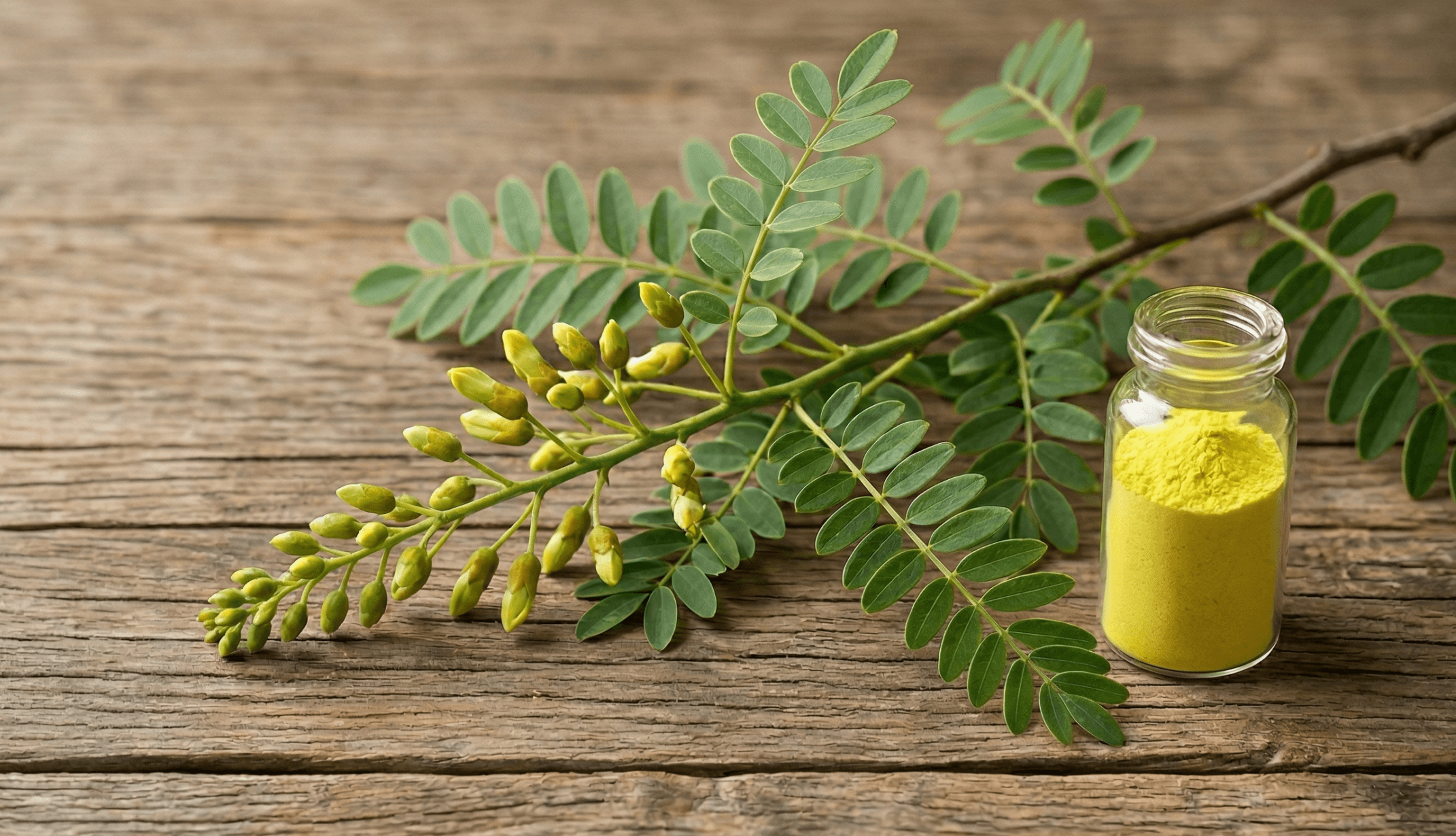
Quercetin is a naturally occurring flavonoid found in many plants. It is one of the most extensively studied natural compounds for its ability to inhibit mast cell degranulation — the process that releases histamine and other pro-inflammatory cytokines responsible for allergic symptoms. Research consistently shows quercetin outperforms pharmaceutical mast cell stabilizers in human cell studies.
Key Research
Quercetin Is More Effective Than Cromolyn in Blocking Human Mast Cell Cytokine Release
Weng Z, Zhang B, Asadi S, et al. PLOS ONE. 2012;7(3):e33805.
DOI: 10.1371/journal.pone.0033805 | PMID: 22470478 | Free PMC Article
This landmark Tufts University School of Medicine study compared quercetin directly against cromolyn (the only pharmaceutical compound marketed as a mast cell stabilizer) using cultured human mast cells and human clinical trials. Key findings:
- Both quercetin and cromolyn effectively inhibited histamine and prostaglandin D2 (PGD2) secretion from human mast cells
- Quercetin was significantly more effective than cromolyn at inhibiting IL-8 and TNF release — inflammatory cytokines that sustain allergic reactions
- Quercetin reduced IL-6 from mast cells in a dose-dependent manner
- Quercetin inhibited cytosolic calcium increases and NF-κB activation — two core mechanisms driving mast cell inflammatory signaling
- Critically: quercetin works prophylactically (before exposure), while cromolyn must be given simultaneously with the trigger or rapidly loses effectiveness
- In two open-label human clinical trials, quercetin significantly reduced contact dermatitis and photosensitivity
Quercetin and Its Anti-Allergic Immune Response (Review)
Mlcek J, Jurikova T, Skrovankova S, Sochor J. Molecules. 2016 May 12;21(5):623.
DOI: 10.3390/molecules21050623 | PMID: 27187333 | Free PMC Article
This comprehensive review examines quercetin’s anti-allergic mechanisms across multiple cell types, finding that quercetin suppresses IgE receptor-mediated mast cell activation, inhibits the secretion of multiple histamine and eicosanoid mediators, and downregulates Th2-type immune responses that underlie chronic allergic conditions.
Mechanism of Action
Quercetin stabilizes mast cells by multiple complementary pathways: it blocks the IgE-FcεRI receptor complex signaling cascade, inhibits intracellular calcium release (which triggers degranulation), and suppresses NF-κB activation that drives cytokine gene expression. This multi-target approach makes quercetin particularly effective for broad-spectrum anti-allergic support.
Relevance to Equine Health
The mast cell biology studied in these human and rat models is directly analogous to the mast cell-mediated hypersensitivity seen in horses with insect bite hypersensitivity, heaves (equine asthma), and skin allergies. Quercetin’s prophylactic effectiveness — working best when given consistently before allergen exposure — aligns well with daily supplementation protocols for horses in high-allergen environments.
Note: These studies provide mechanistic and clinical evidence for quercetin’s anti-allergic activity. Always consult a veterinarian regarding your horse’s specific health needs.
Frequently Asked Questions: Quercetin for Horses
What does quercetin do for horses?
Short answer: Quercetin stabilizes mast cells, reduces histamine release, and suppresses multiple inflammatory pathways — making it one of the most research-supported natural anti-allergic compounds for horses with hypersensitivity conditions. In direct comparison studies, quercetin outperformed cromolyn — the only pharmaceutical mast cell stabilizer — at blocking IL-8 and TNF release. Unlike most anti-allergic interventions, quercetin works prophylactically: it is most effective when given consistently before allergen exposure rather than reactively after symptoms appear. This makes it particularly well-suited to horses in year-round or seasonal allergy management protocols.
Is quercetin better than antihistamines for horses?
Short answer: Quercetin and antihistamines work differently — antihistamines block histamine after it’s released, while quercetin prevents the mast cells from releasing histamine in the first place. For horses with chronic allergic conditions like insect bite hypersensitivity, sweet itch, or equine asthma, preventing histamine release upstream is often more effective than blocking it downstream. Quercetin’s multi-target mechanism — blocking IgE signaling, intracellular calcium release, and NF-κB activation simultaneously — means it addresses the allergic cascade at multiple points rather than just one. For enhanced absorption, quercetin is most effective when paired with isoquercetin. See the isoquercetin bioavailability article for details.
How long does quercetin take to work in horses?
Short answer: Quercetin is a prophylactic — it builds effectiveness over consistent daily use and works best when given before allergen exposure, not after. Most horses show measurable improvement in 4–6 weeks of continuous supplementation. The research is clear that quercetin loses effectiveness rapidly when given simultaneously with an allergic trigger, but is highly effective when pre-loaded consistently. For horses with seasonal allergies, starting supplementation 4–6 weeks before peak season produces the best outcomes. For horses with year-round conditions like heaves, daily ongoing supplementation is the appropriate protocol.
What is the difference between quercetin and isoquercetin for horses?
Short answer: Isoquercetin is the glycoside form of quercetin with significantly higher bioavailability — the body absorbs it faster and at greater quantities, meaning more of the active compound actually reaches the mast cells where it needs to work. Standard quercetin aglycone has approximately 4% oral bioavailability. Isoquercetin, because it is attached to a glucose molecule, is absorbed via intestinal glucose transporters at a much higher rate. For horses where therapeutic effect matters, isoquercetin delivers more consistent blood levels of quercetin than the standard form. See the full isoquercetin bioavailability article for the research.
Is quercetin safe for horses with sweet itch or insect bite hypersensitivity?
Short answer: Yes — quercetin is one of the most scientifically supported natural interventions for horses with insect bite hypersensitivity (IBH) and sweet itch, directly targeting the mast cell and Th2-immune mechanisms that drive these conditions. Insect bite hypersensitivity is the most common allergic skin condition in horses globally. The Culicoides midge allergens that trigger IBH activate IgE-mediated mast cell degranulation — exactly the pathway quercetin blocks at multiple points. For the most comprehensive approach, combining quercetin with isoquercetin, spirulina, and bromelain addresses the allergic cascade from multiple angles. Read more in the spirulina mast cell article and the bromelain absorption article. For overall horse health context, see the Complete Guide to Horse Hydration.
Leave a Reply